
 EN
EN



5052 vs 6061 Aluminum: Which Alloy Is Right for Your Application?
Choosing between 5052 and 6061 aluminum is not simply a question of which alloy is stronger. The right choice depends on how the part will be formed, machined, welded and used in service. Temper, product form, thickness and the applicable material specification should all be considered before one alloy is substituted for the other.
5052 aluminum is often the stronger starting point for formed sheet components, enclosures, tanks and applications where corrosion resistance and bending performance are important. 6061 aluminum is commonly evaluated first for machined components, structural parts and applications where higher strength is required.
This is a starting point rather than a substitution rule. Compare the materials in the temper and product form that will actually be purchased.
5052 vs 6061 Aluminum: Quick Comparison
The main difference is how the two alloys obtain their properties. 5052 is a non-heat-treatable aluminum-magnesium alloy, while 6061 is a heat-treatable aluminum-magnesium-silicon alloy. This affects forming, mechanical strength, machining and the way each material should be specified.
| Selection Factor | 5052 Aluminum | 6061 Aluminum |
|---|---|---|
| Alloy family | Aluminum-magnesium alloy | Aluminum-magnesium-silicon alloy |
| Heat treatment | Non-heat-treatable | Heat-treatable |
| Common conditions | O, H32 and H34 for many sheet and plate requirements | T4, T6 and T651 depending on product form and specification |
| Strength | Moderate strength with useful forming capability | Higher strength in commonly used heat-treated conditions |
| Corrosion resistance | Frequently selected where corrosion exposure is an important factor | Good general corrosion resistance depending on service conditions |
| Formability | Often preferred for bent and formed sheet components | Strongly temper-dependent; T6 requires more care when forming |
| Welding | Commonly used in welded sheet fabrication | Weldable, but the heat-affected region requires design consideration |
| Machining | Usually not the first choice when machining efficiency dominates | Frequently selected for machined engineering components |
| Typical starting point | Enclosures, tanks, formed panels and fabricated sheet parts | Machined parts, brackets, structural members and engineering components |
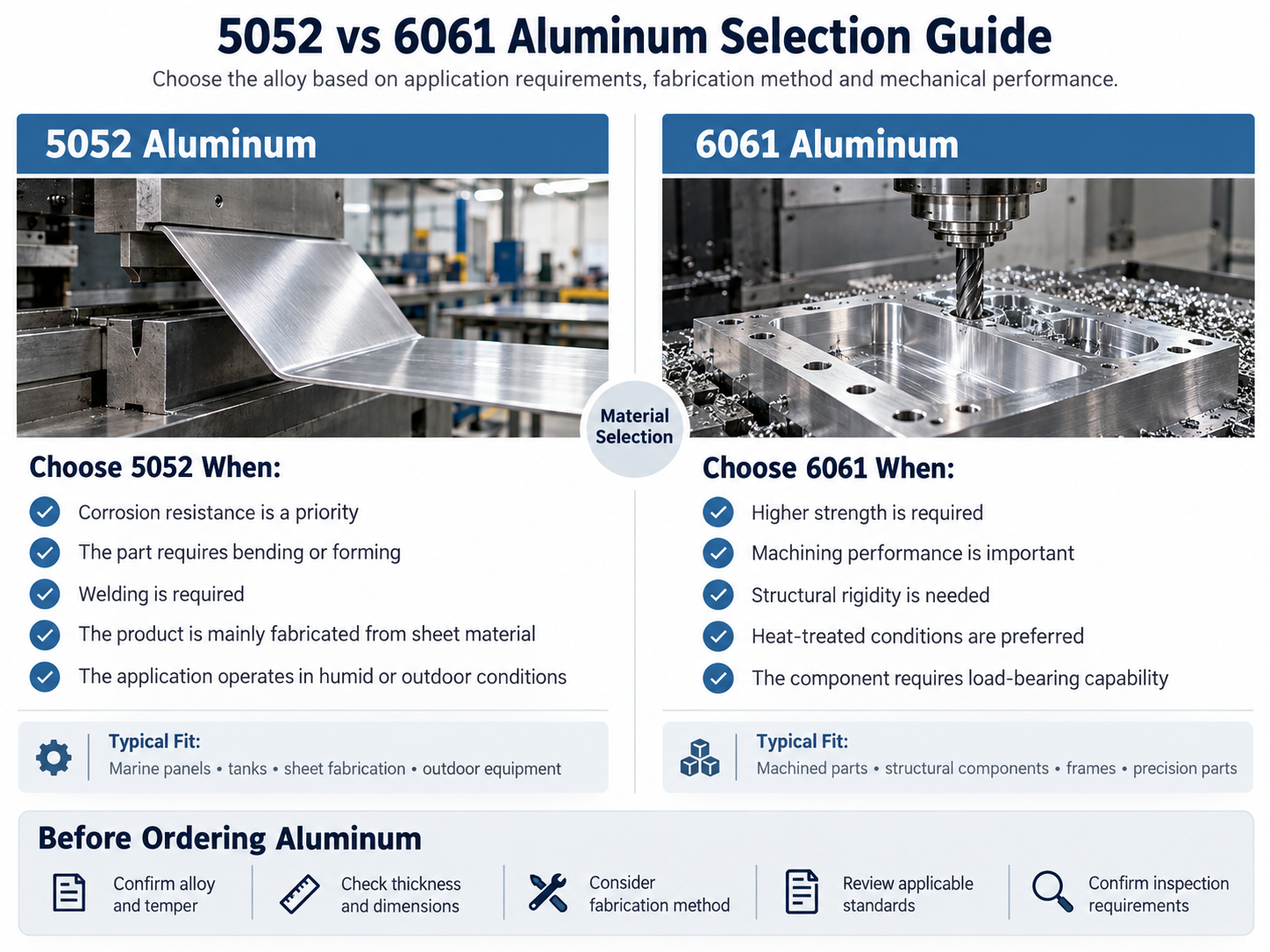
What Are 5052 and 6061 Aluminum?
Focused on Fabrication and Corrosion Performance
5052 is a non-heat-treatable aluminum alloy in which magnesium is the principal alloying element. Its hardened conditions are developed through cold working rather than precipitation heat treatment.
Buyers commonly encounter O, H32 and H34 conditions in sheet and plate applications. The selected temper matters because mechanical properties and forming behavior change with material condition.
See our 5052 Aluminum Sheet & Plate page for product and inquiry information.
Focused on Strength and Engineering Versatility
6061 is a heat-treatable aluminum alloy containing magnesium and silicon. Heat treatment and aging allow substantially different property levels to be achieved depending on the selected temper.
T4, T6 and T651 are common designations, although the available condition depends on product form and specification. A condition selected for machining is not automatically the best condition for severe forming.
See our 6061 Aluminum Sheet & Plate page for supply information.
Why Temper Matters in a 5052 vs 6061 Comparison
Alloy number alone is not a complete purchasing specification. A quotation for "5052 sheet" or "6061 plate" should also identify the temper. Comparing two quotations without checking material condition can result in two products with very different forming or strength characteristics.
Strain-Hardened and Stabilized
H32 is commonly associated with fabricated 5052 sheet applications. It provides a practical combination of strength and formability, but bend behavior still depends on thickness, bend radius, rolling direction and tooling.
Solution Heat-Treated and Artificially Aged
T6 provides the higher strength that makes 6061 attractive for many engineering applications. That higher strength also means it should not be treated as equivalent to a softer condition when substantial forming is required.
5052-H32 vs 6061-T6 Mechanical Properties
Comparing defined tempers is more useful than comparing alloy names alone. 5052-H32 and 6061-T6 illustrate the basic engineering trade-off: 5052-H32 is commonly associated with formed sheet fabrication, while 6061-T6 provides a substantially higher mechanical strength level.
5052-H32
6061-T6 / T651
Values are provided to explain the general property difference. Mechanical requirements vary with thickness, product form, temper and applicable specification. Final acceptance should be based on the purchase specification and material certificate.
Strength: Is 5052 or 6061 Aluminum Stronger?
In commonly compared conditions, 6061-T6 provides higher strength than 5052-H32. This makes 6061 a common candidate for machined brackets, structural components and applications where load requirements have a strong influence on material selection.
Higher strength does not automatically make 6061 the better sheet fabrication material. A component with several tight bends may place more value on forming behavior than on the highest available yield strength.
Corrosion Resistance: 5052 vs 6061
5052 is frequently evaluated for humid, outdoor and marine-related fabricated components because corrosion performance is one of its established strengths. It is commonly considered for tanks, enclosures, panels and other fabricated sheet products.
6061 also provides good corrosion resistance in many atmospheric applications. Final material selection should still consider the actual service environment rather than relying only on broad descriptions such as "outdoor use" or "marine use."
Define whether the component sees indoor humidity, occasional washing, salt spray or continuous water exposure.
Fasteners and adjacent metals should be reviewed where galvanic corrosion may become relevant.
Coating, anodizing, drainage and maintenance requirements can influence the final material decision.
Formability and Bending
For fabricated sheet components, 5052 is often the more practical starting point. It is widely used for folded covers, enclosures, panels, tanks and other parts where bending is an important part of production.
Bendability should not be judged from alloy number alone. Temper, sheet thickness, inside bend radius, rolling direction and tooling all influence the result. A design that bends successfully in one condition may require a larger radius or different process in another.
6061 can also be formed, but severe bending in a high-strength condition such as T6 requires more careful evaluation. If forming is a major part of manufacturing, the fabrication route and required final condition should be planned before the material is ordered.
Welding 5052 and 6061 Aluminum
Both alloys are used in welded aluminum fabrication, but the properties of the incoming material should not automatically be treated as the properties of the finished welded assembly.
For a load-bearing welded assembly, confirm the welding procedure, filler selection, inspection requirements and required properties after fabrication rather than approving the design only from the properties of the unwelded base material.
Machining: Why 6061 Is Often Preferred
When a component will be produced mainly by milling, drilling, turning or other machining operations, 6061 in an appropriate heat-treated condition is often evaluated before 5052.
This does not mean every 6061 condition machines identically or that 5052 cannot be machined. The useful comparison is the actual material condition, component geometry, tolerance, required surface finish and machining process.
Confirm alloy, temper, stock dimensions and available machining allowance.
Thin walls, deep pockets, threaded features and precision holes create different machining requirements.
Define dimensional tolerance, surface requirements and inspection criteria before production.
5052 vs 6061 Aluminum Density and Weight
The density difference between 5052 and 6061 is relatively small. In most purchasing decisions, fabrication, strength, corrosion performance and product availability have a greater influence than the small difference in alloy density.
For purchasing and logistics calculations, use the actual supplied dimensions and the density associated with the specified material rather than assuming two quotations represent identical finished dimensions or tolerances.
5052 vs 6061 Aluminum Applications
Equipment covers, electrical enclosures, panels and fabricated housings where bending and corrosion resistance are important.
Sheet-metal assemblies where welding, forming and environmental exposure need to be considered together.
Mounting blocks, brackets, fixtures and engineered parts where machining performance and strength are priorities.
Frames, profiles and structural parts where higher mechanical strength is more important than severe sheet forming.
How to Choose Between 5052 and 6061 Aluminum
Start with the finished part rather than with the alloy name. A practical material selection process defines service requirements first and then works backward through manufacturing and purchasing requirements.
Identify load, service environment, expected life and any project-specific material requirements.
Confirm whether the part will be bent, welded, machined, anodized, coated or processed further.
Compare the actual purchase conditions rather than making a decision from alloy numbers alone.
Verify dimensions, tolerance, standard, documents and acceptance criteria before ordering.
| Main Requirement | Material to Evaluate First | What Still Needs Confirmation |
|---|---|---|
| Several bends in a sheet-metal part | 5052 in a suitable temper | Thickness, bend radius, rolling direction and tooling |
| Machined bracket or mounting component | 6061 in the specified machining condition | Tolerance, blank size, finish and inspection |
| Corrosion-sensitive fabricated enclosure | 5052 is often a practical starting point | Actual exposure, fasteners, coating and drainage |
| Higher-strength structural part | 6061 may be the stronger candidate | Temper, product form, loads and engineering approval |
| Welded assembly | Evaluate the complete design | Welding procedure, filler, heat-affected region and final properties |
Purchasing and ASTM B209 Considerations
For aluminum sheet and plate, ASTM B209/B209M is one of the specifications buyers may reference where applicable. A purchase order should still state the complete material requirement rather than relying only on a standard number.
Frequently Asked Questions
What is the main difference between 5052 and 6061 aluminum?
5052 is a non-heat-treatable aluminum-magnesium alloy commonly associated with formed and welded sheet fabrication. 6061 is heat-treatable and is commonly selected when higher strength and machining capability are important.
Is 5052 stronger than 6061?
In commonly compared conditions such as 5052-H32 and 6061-T6, 6061-T6 has the higher strength level. Strength alone should not determine material selection because forming and service requirements may favor 5052.
Is 5052 or 6061 better for bending?
5052 in a suitable temper is often preferred for bent sheet components. Final bend performance depends on temper, thickness, bend radius, rolling direction and tooling.
Which aluminum alloy is better for machining?
6061 in an appropriate heat-treated condition is commonly preferred for machined engineering components. The correct blank condition should still be selected according to the drawing and machining requirements.
Can 6061 replace 5052 aluminum?
Not automatically. A substitution should be reviewed against temper, product form, forming and welding requirements, corrosion exposure and the finished component specification.
Should I compare 5052-H32 with 6061-T6?
Yes, when those are the actual conditions being considered for purchase. The comparison should remain specific to the relevant product form, thickness and material standard.
Need Help Comparing 5052 and 6061 Aluminum?
Send your application, alloy or temper requirement, dimensions, quantity, drawing and required documentation. Voyage Metal can review the supply requirement before quotation and help clarify the material specification for your inquiry.