
 EN



5083 vs 5086 aluminum comes down to a real alloy difference, followed by a project-specific choice. Both are non-heat-treatable aluminum-magnesium alloys used for marine plate. 5083 has higher registered magnesium and manganese ranges; supplier guidance generally places it above 5086 in strength. That does not make every 5083 plate stronger than every 5086 plate: temper, thickness and the product specification still control the comparison.
For a specified vessel or repair, buy the approved grade and condition. For an open selection, compare the required strength, fabrication and marine inspection scope before comparing prices. This guide explains those decisions for rolled sheet and plate, not cast tooling plate or extruded profiles.
5083 vs 5086 Aluminum: Key Differences
The composition ranges below are mass percentages from the Aluminum Association’s December 2025 registration record. They describe alloy limits, not the measured chemistry of an individual delivery.
| Comparison | 5083 aluminum | 5086 aluminum |
|---|---|---|
| Magnesium range | 4.0–4.9% | 3.5–4.5% |
| Manganese range | 0.40–1.0% | 0.20–0.7% |
| General strength positioning | Higher-strength option in Alro’s sheet-and-plate alloy overview | Described in the same overview as similar, with somewhat lower strength |
| Strengthening route | Non-heat-treatable; supplied condition and cold work matter | Non-heat-treatable; supplied condition and cold work matter |
| Documented application examples | Marine structures and shipbuilding plate | Patrol and workboat hulls, marine fabrication |
| Purchasing implication | Check the specified temper and properties; do not assume a thickness reduction is allowed | Do not reject an approved 5086 specification merely because another alloy has a higher general strength rating |
Sources: Aluminum Association composition limits, printed page 10, Alro sheet-and-plate alloy descriptions, page 6-58, and the application references below.
The chemistry ranges overlap. A magnesium reading alone is therefore not enough to identify the alloy; use the full material identification and traceable test documentation. Chemistry also cannot prove a specific plate’s mechanical performance.
Which Grade Is Stronger?
5083 is generally the higher-strength choice in supplier alloy overviews. Alro explicitly distinguishes 5086 as the somewhat lower-strength sister alloy. This is useful selection context, not a guaranteed difference for every temper or thickness.
Do not decide from two strength numbers unless they describe comparable products. First ask whether each value is a guaranteed minimum or a typical test result. Then check the temper, thickness range, test basis and governing specification. A typical value for one condition should not be treated as the guaranteed performance of a different condition.
Temper means the material’s processing condition. Annealed O plate and strain-hardened H plate are different conditions, so comparing them changes more than the alloy. Ask for the specified tensile and yield requirements for each quoted item; yield strength concerns the onset of permanent deformation, while tensile strength concerns the maximum tensile stress in the test.
A higher general strength rating does not authorize thinner hull plating. The responsible designer must assess the actual properties together with geometry, loading and welded-joint requirements.
Which Applications Favor Each Grade?
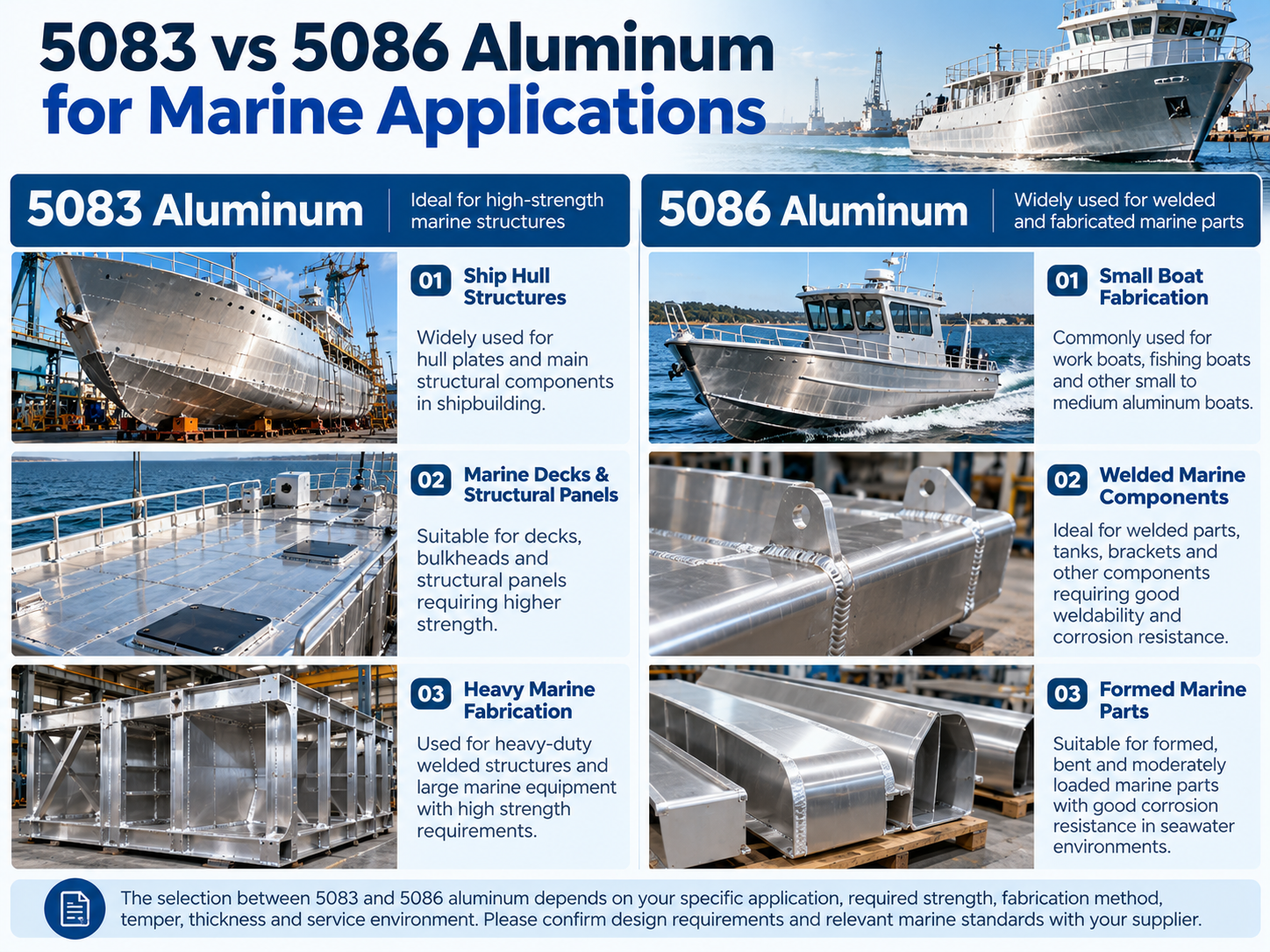
5083 is a candidate where an approved design calls for high-strength welded marine plate. Atlas identifies shipbuilding as a principal use. 5086 is also a marine construction alloy: Kloeckner lists patrol and workboat hulls among its applications. These uses overlap, so “5083 for ships, 5086 for boats” is not a reliable selection rule.
For a new build, start with the designer’s alloy and temper requirements. For a replacement panel, establish the original material and repair approval requirements. For a formed component, compare the specified condition with the drawing and bend requirements. Neither application name nor hull size establishes interchangeability.
The two product routes are 5083 aluminum sheet and plate and 5086 aluminum plate. They help identify the intended supply item; the project specification determines acceptance.
Does “Marine Grade” Establish Corrosion Performance?
Both alloys are used in seawater-related applications, but that does not establish a universal corrosion winner. “Marine grade” also does not prove that a delivery meets the required corrosion tests or certification. Specify the exposure, supplied condition and acceptance requirements rather than choosing from an alloy number alone.
Write the required product specification and edition into the inquiry. For marine plate, ASTM B928/B928M may be relevant where specified; a general sheet-and-plate requirement should not be assumed to carry the same acceptance conditions. Ask the supplier to explain any difference between the requested standard and the offered material rather than accepting a list of standard names as proof of compliance.
Also identify any classification-society or independent-inspection requirements before ordering. A supplier’s general quality certificate is not the same document as the material or inspection certificate requested for a specific delivery. Agree what evidence must accompany the material and who needs to approve it.
What Changes When the Plate Will Be Welded or Formed?
Both grades are weldable according to their supplier references. However, good weldability does not mean that a welded assembly retains the supplied plate’s properties everywhere. In particular, welding strain-hardened aluminum can affect the strength near the weld. For 5083, supplier technical guidance explicitly identifies strength reduction in the heat-affected zone. The fabrication design must account for the relevant welded condition.
Tell the supplier whether the plate will be welded, bent or machined, but keep responsibility clear. A material quotation is not a qualified welding procedure or approval of a fabrication design. The fabricator and responsible engineer should determine the welding procedure, filler selection and inspection requirements.
For formed parts, provide the drawing, thickness, temper and bend requirements. Do not copy a bending recommendation from a different thickness or condition. Tooling and fabrication details can affect the result, so a drawing is more useful than a broad request for “easy-to-bend marine plate.”
How to Compare Two Supplier Quotations
Consider a hypothetical inquiry that names 5086 plate. One supplier offers that item with the requested documents. Another suggests 5083 but leaves the temper and inspection scope unstated. Even if the second price is lower, the offers are not yet comparable.
Resolve the differences in this order:
- Confirm the permitted alloy. Keep the specified grade unless the project’s approval process accepts a substitute.
- Confirm the material condition. Ask for the full temper and the applicable property requirements.
- Match the dimensions. Check thickness, width, length and tolerances, including flatness where relevant.
- Match the acceptance package. Include the product standard, requested certificates, testing and inspection responsibilities.
- Compare the commercial scope. Review quantity, packing, destination, quoted delivery basis and any exclusions only after the material scope is clear.
Put agreed deviations in writing. A note such as “equivalent material offered” is not a substitute for identifying the actual alloy and obtaining acceptance.
Can 5083 Replace 5086 Aluminum Plate?
Treat substitution as a project decision, not a purchasing shortcut. Send the proposed alloy, temper, thickness, specification and documentation to whoever controls material approval. They can assess the change against the design, service and fabrication requirements.
If the project allows either grade, request quotations on a consistent basis and record that approval with the order. If it specifies only one, ask for that material first. Availability or price may justify reviewing an alternative, but neither establishes technical suitability.
For requirements outside these two grades, review the broader aluminum sheet and plate range.
Frequently Asked Questions
Should I specify 5083-T6 or 5086-T6?
No. T6 is not the appropriate supply designation for these non-heat-treatable alloys. Ask the project team to confirm the required O or H condition and include it with the alloy number.
Is a mill test certificate enough for every marine order?
Not automatically. Check the document against the purchase specification and required inspection scope. Where additional testing, traceability or third-party approval is required, agree it before accepting the order.
Which is cheaper, 5083 or 5086?
Use current quotations for the same purchasing scope. Temper, size, quantity, documentation and delivery arrangements can change the offer. This guide does not provide a live price comparison or assume either grade is always cheaper.
Technical References and Scope
This is a source-based purchasing guide, not a report of Voyage Metal laboratory tests or vessel trials. The composition and general comparison references are linked above. Additional technical sources are:
- Atlas Steels: 5083 data sheet, supporting alloy behavior, shipbuilding use and welded-zone cautions.
- Kloeckner Metals: 5086 sheet, supporting the non-heat-treatable classification, weldability and application examples.
Supplier literature is background information, not certification of a Voyage Metal order. Use the applicable specification edition and delivery documents for acceptance. The quotation scenario above is illustrative, not a customer case.
Next Step: Discuss Your Plate Requirement
Once the project requirements are clear, send your requirements to Voyage Metal. Include alloy, temper, thickness × width × length, tolerances, surface, quantity, product standard, documents, packing, application and destination. If you want an alternative quoted, state whether substitution has already been approved or still requires review. The team will confirm the requested supply scope before quoting.